

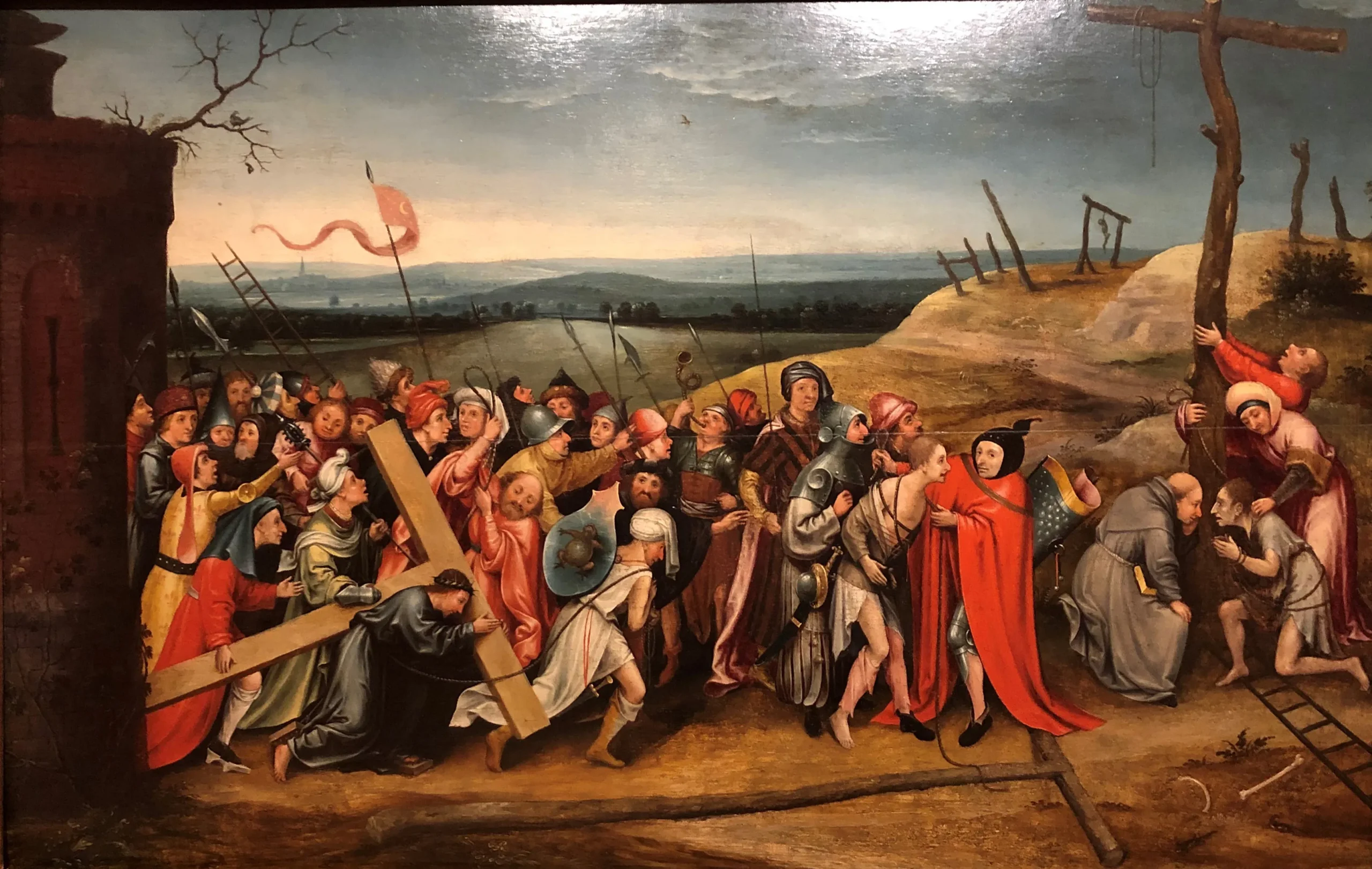
Throughout the centuries, humanity has been held in the grip of a stubborn illusion: the conviction that the salvation of the world depends on the victory of one political camp over the other. In our own time, propelled by digital megaphones and a permanent state of outrage, this dynamic has escalated into absolute polarization. We are required to choose: left or right, progressive or conservative, globalist or nationalist. But the greatest tragedy of our age is not that the world is on fire from this polarization; the true tragedy is that the fire has leapt onto the ship of the Church. Many today confuse the political arena with the Kingdom of God. In this essay we return to the Truth (In Veritatem) and discover how, already in the first century, Jesus Christ engaged with precisely this deadly, worldly polarization.
If we look at the present state of public debate, we see a struggle to the death. Political discourse has taken on religious features. Because the transcendent — our gaze toward God and eternity — has been cut out of our culture, politics has become for modern man the only remaining space for the making of meaning. The result is a merciless struggle. Whoever disagrees with one camp is not merely an opponent with a different view, but a heretic, a danger to society, someone who must be destroyed or ‘cancelled.’
The French anthropologist and cultural philosopher René Girard described this phenomenon as mimetic rivalry (imitative desire). Two warring parties seem in their rhetoric to be each other’s absolute opposites, but the longer and more fiercely they fight, the more they come to resemble one another. The far left and the far right today employ exactly the same weapons: absolute moral superiority, blind hatred, exclusion, and the conviction that the world will only be saved when the other has been eradicated. They have become, in Girard’s phrase, each other’s ‘monstrous double.’ It is a thoroughly earthly, carnal mechanism that revolves around the lust for domination, or what Saint Augustine called the libido dominandi.
It is understandable that the unredeemed world should behave in this way. What is shocking, however, is the observation that the Church — called to be in the world but not of the world — has allowed itself to be drawn into this fray. Today we see believers who confuse their political convictions with their theology. We see Christians who reduce the Bible to a political manifesto and the Church to an action group.
But anyone who reads the Gospels carefully discovers something breathtaking: Jesus Christ stood, in the first century, before exactly these same polarized forces, and He categorically refused to play along in their worldly game.
The Political Battlefield of the First Century
To grasp the radicality of Jesus’ conduct, we must hold the political context of the first century clearly before our eyes. The society into which Christ became incarnate was deeply torn and at least as polarized as our own. Palestine was occupied by the Roman Empire. Theological and political tensions could be cut with a knife, and the society was divided, broadly, into sharply demarcated camps that translate, with surprising ease, into contemporary categories:
1. The Sadducees: the pragmatic, elite class. They administered the temple and held the wealth. They struck compromises with the Roman occupier in order to preserve the peace (and their own position of power and luxury). Theologically they were liberal (they did not believe in the resurrection or in angels). In modern terms: the cosmopolitan elite, the establishment politicians, the globalists, attached to the preservation of the status quo and economic stability — even at the expense of their own identity.
2. The Pharisees: the conservative, nationalist puritans. They hated Roman influence and wished to save the people through an extremely strict, uncompromising observance of the traditional laws. They had the support of the common man and despised the corrupt elite of the Sadducees. In modern terms: the right-wing conservative populists, who hammer on tradition, identity, and the exclusion of ‘impure’ elements (the tax collectors and sinners).
3. The Zealots: the radical activists and revolutionaries. For them political violence was a legitimate means. They carried daggers and committed assassinations against Romans and collaborators. They believed that the Kingdom of God could be realized only through an armed, political uprising. In modern terms: the extremist action groups (whether radical-left, antifa, or radical-right) who believe in disruption and revolution.
4. The Essenes: the separatists. They saw the whole society as rotten and withdrew into monastic-style communities in the desert (at Qumran) to preserve their own purity and to wait for the end of time. In modern terms: the ‘preppers’ or those Christians who choose the ‘Benedict Option,’ surrendering the culture and isolating themselves out of fear of contamination by the secular world.
Every Jew of that period stood under immense pressure to declare a side. They asked one another constantly: “On whose side do you stand?”
And then Jesus of Nazareth stepped into the public square.
The Frame Broken: The Strategy of Truth
What we see in the Gospels is a chain of attempts by these factions to ‘frame’ Jesus. They wanted to force Him to draw a party card. If He was the promised Messiah, they reasoned, then He would surely legitimize their political agenda and destroy their enemies.
The most famous example of this polarizing trap is the moment when the Pharisees (the nationalists) and the Herodians (the collaborators) — groups who normally bore each other a deadly grudge — conspire together to ensnare Jesus. They put to Him a binary, purely political question: “Is it lawful to pay taxes to Caesar, or not?” (Matthew 22:17, RSV-CE).
This is the classic method of the world: the weapon of ‘outrage’ and political framing.
If Jesus says “Yes, pay the tax,” He betrays the people, takes the side of the oppressive elite, and immediately loses all His followers. The Pharisees would mark Him a traitor.
If Jesus says “No, do not pay,” He breaks Roman law, and the Herodians can have Him arrested at once for sedition and terrorism.
It is, on its face, an inescapable dilemma: it is left or right, for or against. But Jesus recognizes the pride and the demonic character of this false antithesis. He asks for a coin, points to the image of Caesar, and speaks the words that would shake the foundations of human politics forever: “Render therefore to Caesar the things that are Caesar’s, and to God the things that are God’s.” (Matthew 22:21, RSV-CE).
With this single answer He refuses to fit Himself into the world’s frames. He delegitimizes the absolute claim of the state (Caesar may have money, but not the human soul), and He reminds the theocratic nationalists that God’s Kingdom does not coincide with earthly power. He reveals a ‘Third Way’: the Way of the Kingdom of God, which wholly transcends the superficial categories of worldly powers.
Jesus, by the way, did not avoid the conflict. He was no pacifist diplomat looking for a cowardly “middle.” On the contrary. He was what the aged Simeon already prophesied in the temple: “a sign that is spoken against” (Luke 2:34, RSV-CE). Jesus criticized the hypocrisy of every camp. He rejected the legalistic pride of the Pharisees, but also the secular arrogance of the Sadducees and the violence of the Zealots. Because He refused to speak the world’s language, the hostile camps — who normally fought one another to the death — at last formed a monstrous alliance. Pilate (the Roman) and Herod (the local ruler) became friends, suddenly, on the day of His trial (cf. Luke 23:12). The world’s enemies always unite when confronted with absolute Truth.
The Tragedy of the Politicized Church
What does all this mean for us, the Church of the twenty-first century? The bitter reality is that many Christians today have grown blind to this divine dynamic. We see a frightening confusion between the Kingdom of God and party politics.
C. S. Lewis described this snare masterfully in The Screwtape Letters (1942). In that book the elder demon Screwtape instructs his nephew Wormwood in the art of damning men. Screwtape explains that it makes no difference whether the “patient” (man) becomes an extreme patriot or, on the contrary, an extreme pacifist; whether he is far-left or far-right. So long as he raises his political conviction into his true religion. Screwtape writes with delight:
“Let him use his faith as a means to his political ends. Once we get him to the point where worldly politics becomes the most important thing in his life, and the Church only a useful instrument for realizing his social dreams, then we have him.”
This is exactly the disease that afflicts the Church today. On the one hand — often on the progressive side — the Gospel is reduced to a left-wing social-political action program. Jesus is depicted as the ultimate “social justice warrior,” a kind of early Karl Marx who came only to solve economic inequality and climate problems. The transcendent disappears, the sacraments become mere symbols of community, and the Church is reduced to an NGO, a department of Amnesty International.
On the other side — often on the conservative side — an equally great error threatens. There the Gospel is reduced to a cultural coat of arms against advancing modernity. Jesus becomes a mascot for traditional Western values, nationalism, and patriotism. Theology is militarized in order to win a culture war against the left. Here one risks forgetting charity (Caritas), humility, and the cross, in the supposition that swords must be drawn to save Christian civilization at the ballot box and through political ‘outrage.’
Both flanks suffer from what Saint Augustine described in his magnum opus De Civitate Dei (The City of God). Augustine warned that there are two cities: the Earthly City and the City of God. The Earthly City is built on the love of one’s own ego and on the drive for power over others. The City of God is built on the love of God, even unto the readiness for self-sacrifice.
When we suppose that we can realize heaven on earth by winning elections, passing laws, and silencing our political enemies online with sharp frames or deliberate provocations, we have placed ourselves wholly within the logic of the Earthly City. We use the mud of the world in the vain hope of building a heavenly castle out of it. We forget the words of Christ before Pontius Pilate: “My kingship is not of this world; if my kingship were of this world, my servants would fight…” (John 18:36, RSV-CE).
The Pharisaism of the Present and the Vanished God
The result of this ecclesial politicization is shuddering: the voice of God has become inaudible in the public clamor. When Christians get caught in mimetic rivalry with their political opponents, they lose their ‘saltiness.’ Instead of being light in the darkness, they become merely one more shouting voice in the asylum of secular society.
We see it happen in debates, on social media, and, sadly, even in parishes: believers accuse the secular elite of intolerance and ‘cancel culture,’ but then employ those very same mechanisms of exclusion to police their own political or theological purity. Pharisaism is not dead; it has merely put on a new coat. Both extremes of the political spectrum demand absolute infallibility and never show repentance. To apologize is regarded as weakness. That is the ultimate manifestation of the deadly sin of Superbia (pride). True Christianity, by contrast, is built on the Mea Culpa — the humble acknowledgment of one’s own fallibility.
When the Church takes sides in this worldly battle, we make God invisible. For God rarely reveals Himself in the power structures of the world. Recall the prophet Elijah on Mount Horeb (1 Kings 19). Elijah had fled after a deadly political conflict with Queen Jezebel. He sought God. There came a fierce hurricane that split rocks, but God was not in the hurricane. There came an all-shattering earthquake, but God was not in the earthquake. There came a sea of fire, but God was not in the fire. Where was God? He was in the still small voice.
God is not in the political hurricanes, nor in the media storms, the outrage, and the ‘frames’ of the modern criers of the times. Whoever seeks God in the violent dynamic of left and right will not find Him.
In Veritatem: The Way Out for the Christian
Does all of this mean that the Christian must withdraw entirely from society? Is the conclusion a despondent, apathetic walking-away from public debate (as the Essenes did in the first century)? Not at all. The Church calls us instead to stand in the midst of the world — but as bearers of an entirely different order.
The Christian is not a-political, but rather, as it were, supra-political (above politics). We have a duty to engage for the common good, to vote, to debate, and to denounce injustice. But we do so from the absolute knowledge that the salvation of the world will never come through the prime minister’s office, parliament, or a worldly leader. “Put not your trust in princes, in a son of man, in whom there is no help,” warns Psalm 146:3 (RSV-CE).
To live In Veritatem (in the truth) is to break through the false frame of polarization. In practice this means:
- Refuse the Idol of Ideology: we must always submit our own political preferences to the critique of the Gospel. No party is perfectly Christian. If we never feel any pain or conflict between our political party and our faith, the chances are good that we have adapted God to our politics rather than the other way around.
- Continue to See the Other as an Image-Bearer: in the polarized world, the political opponent is an enemy who must be destroyed. For the Christian, the political opponent is, first and foremost, the neighbor, made in the image and likeness of God (Imago Dei), for whom Christ has equally shed His blood. This forbids demonization, even where we contest a conviction with the full force of our intellect.
- The Weapons of the Spirit: we cannot fight the lies of the world with the weapons of the world. Even when our opponents employ malicious ‘frames’ and ‘cancellation,’ the Christian’s answer is not to strike harder with arrogance and refuse ever to ask forgiveness. The Christian’s weapon is the Truth spoken in love (Caritas), joined to the meekness that characterizes Christ. Where the Earthly City rules by power-grabs and domination, the Church conquers through the blood of the martyrs and the witness of the saints.
Conclusion
The pull of contemporary polarization is strong, because it plays on our deepest fears and on our pride. We want to stand on the ‘right side of history,’ whether by preserving the culture (the right) or by deconstructing it (the left). We are tempted, daily, to step into the arena and shout along.
But let us fix our gaze on the ultimate symbol of our faith: the Crucified. At the cross we see the ultimate consequence of worldly polarization. The religious purists (the Pharisees) and the worldly globalists (the Romans and the Sadducees) alike rejected Him. In the eyes of the world, He was destroyed. And yet, in that very moment, in absolute powerlessness, in silence and in divine love, the spine of evil was forever broken.
The Church does not survive by copying the politics of the world, but by embracing that cross. Only when we refuse to participate in the madness of the two camps can we again be what at our deepest we are called to be: the lighthouse of eternal Truth, standing immovable in the midst of the temporal, raging waves of the worldly struggle. That is the only true revolution. That is the Third Way.
Leave a Reply